Tour of the interface
Learn the parts of the window that never move, so every other page can just say "the sidebar" and you know where to look.
Moonshine has one screen. The middle changes with the tab you are on; everything around it stays put.
| Region | Where | What lives there |
|---|---|---|
| Top bar | Across the top | Project, projector, tabs, save state, sharing, help, who else is here, your account |
| Sidebar | Left, collapsible | Properties and lists for the current tab |
| Main pane | Center | The tab itself |
| Scene graph | Bottom, collapsible | The node view of the project |
| Status bar | Bottom edge | Connection, users, locks, card dock |
| Floating cards | Anywhere over the main pane | Preview and Playback, draggable |
The top bar
Left to right:
MOONSHINE — the wordmark. It is not a button.
Project name — click it to open the Projects window and switch to another project.
Projector selector — shows the name of the currently selected projector, or Projectors when none is selected. Hover it to drop down the list under the heading Select Projector: each row has the projector's color swatch, its name, a lock indicator if someone else is holding it, and a tick if it is the current one. Manage Projectors at the bottom of the list — and clicking the selector itself — opens the projectors view where you edit settings.
The selected projector matters more than it looks. The Warp tab, the Mask tab and much of the Scene tab all act on the projector currently selected here.
Tabs — the views:
| Tab | What you do there |
|---|---|
| Assets | The media and model library: upload, organize, preview — see Projects & Media |
| Scene | The 3D view: place surfaces and projectors, choose display modes — see Building the Scene |
| Warp | Per-projector 2D alignment: 4-corner and bezier mesh — see Alignment |
| Mask | Per-projector masking — see Masking |
| Playback | Playlists and transport — see Playback |
| Monitor | Connection, projector health and logs — see Monitoring |
| Admin | Users and sessions. Only appears for administrator accounts |
Tabs stay loaded once visited, so switching back and forth does not reset what you were doing.
Then the right-hand cluster:
Save dot — a single small dot that reports whether your work has reached the show computer. Hover it for the detail:
| Dot | Tooltip | Meaning |
|---|---|---|
| Amber, pulsing | Saving… | Changes are on their way |
| Amber, pulsing | Warp edits not baked — click Bake Warp to commit | Warp work is waiting on a bake — see Baking and reverting |
| Green | Saved just now / Saved 12s ago / Saved at 14:32:05 | Everything is written |
| Gray | No changes yet | Nothing has been edited this session |
There is no Save button and no save shortcut. Saving is continuous; the dot is how you check on it.
Share button (QR icon) — opens the dialog for connecting another device. See Join from another device.
Help button (?) — a small menu with two entries: Keyboard Shortcuts, which opens the full shortcut sheet (also on ?), and Docs, which opens this documentation in a new tab.
Presence avatars — one circle per person signed in, initial-lettered and color-coded. Yours has a ring around it. Click somebody else's avatar to follow their Scene camera; a chip appears reading Following plus their name, with an ✕ to stop. See Following an operator.
Your username — click for the account menu, which currently holds Logout.
Narrow windows
On a tablet or phone the tab strip collapses into a ☰ menu that also shows the name of the view you are on. On a phone the project name and projector picker move into that menu too, as touch-friendly rows.
The sidebar
The left panel carries the controls for whatever you have selected. Its contents change per tab:
| Tab | Sidebar |
|---|---|
| Projectors | Projectors — the list of projectors, plus + Add Projector and the output rectangle readout for the selected one |
| Assets | Asset Browser — type filters (All / Meshes / Images / Videos), the folder tree, and either the upload drop zone or the selected asset's details |
| Scene | Properties — the properties of whatever is selected, plus controls for the active mode |
| Warp | Properties — the 4-Corner / Bezier Mesh switch and that mode's controls |
| Mask | Properties — mask tools and layers |
| Playback | Asset Browser on top, Playlists underneath |
| Monitor, Admin | None — those views use the full width |
Three things to know:
- Collapse it with the « button on its edge, expand it again with ». \ does the same thing from the keyboard.
- Resize it by dragging its right edge. The width is remembered for you.
- Panels that are locked by someone else appear dimmed and refuse edits rather than silently discarding them.
The scene graph panel
The bottom panel holds the node view of the project: the scene, its surfaces, their materials and textures, the projectors, their warps and selection sets, and any media or playlists you have dragged in.
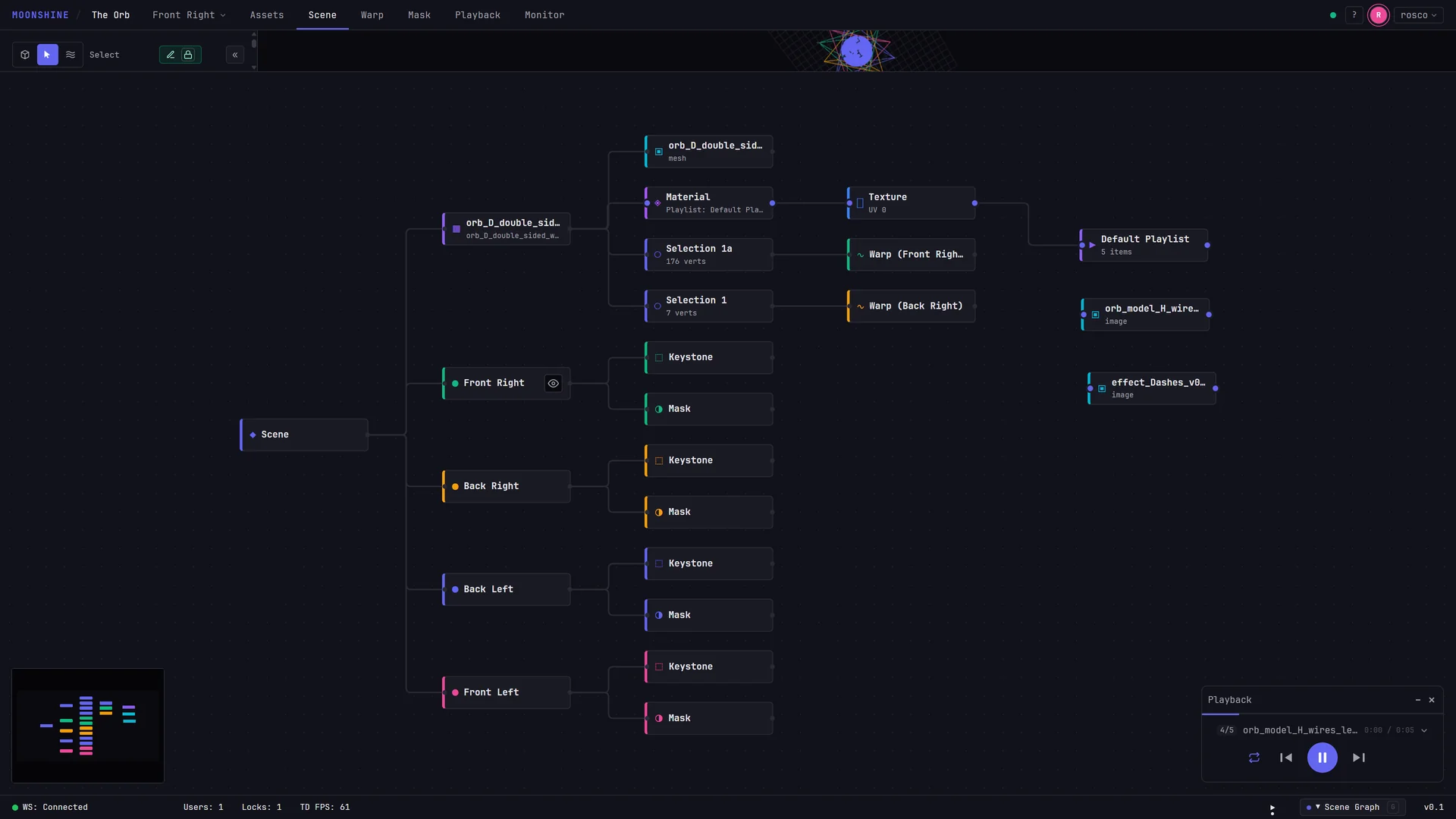
- Open and close it with the Scene Graph pill in the status bar, or G.
- Resize it by dragging its top edge.
- Right-click empty space for Add Projector, Add Mesh (Plane / Box / Empty) and Add Playlist; right-click a node for the actions that apply to it.
- With the pointer over the graph, F fits everything into view.
The graph is also where media gets attached to a surface — see Putting media on a surface and The scene graph.
The status bar
Covered in detail in First launch. In short: connection state on the left, then Users and Locks counts and the engine frame rate; on the right, the card dock, the Scene Graph pill and the version number.
Floating cards
Two panels float over the main pane so you can keep an eye on the render and the transport from any tab:
- Preview — a small 3D view of the surface with the live render on it.
- Playback — the transport: progress, current item, play/pause, previous/next and loop.
They behave like small windows:
- Move them by dragging the title bar. Dropping one near a corner — or alongside the other card — snaps it into place, and the two never overlap.
- Resize from the bottom-right corner. Preview resizes in both directions; Playback only in width.
- Minimize (–) parks a card without forgetting it; Hide (✕) closes it.
- The dock icons in the status bar bring them back: a dot under an icon means that card is on screen, a dimmed icon means it is hidden. Clicking cycles between minimized and visible.
- A card disappears on the tab that already contains it — Preview on Scene, Playback on Playback — and its dock icon disappears with it.
Right-clicking inside the Preview card gives you Home (return the little camera to its default), Auto-rotate (toggle, with the current state shown beside it), Refresh stream (re-request the video feed if it has stalled) and Open in Scene. If the card shows No scene mesh, the project has no surface yet.
Getting around faster
- / opens the command palette — type a few letters to jump to a tab, add a projector or mesh, select a projector by name, toggle panels, or open the project browser. See Command palette.
- 1 to 9 select projectors by position in the list.
- Ctrl+Z undoes, Ctrl+Shift+Z redoes (Cmd+Z and Cmd+Shift+Z on a Mac). Masking and warp sculpting keep their own histories, so the same keys undo inside whichever of those you are working in.
- ? opens the full keyboard shortcut sheet. See Keyboard shortcuts.
Single-key shortcuts and text fields
Shortcuts like G and \ are ignored while your cursor is in a text field, so renaming a projector "Garden" will not toggle panels underneath you.
Undo history is not permanent
Switching projects clears it, and so does losing the connection to the show computer. Once the dot in the status bar goes gray, whatever you did before that is no longer undoable.
Next: Your first mapping.