Editing a surface together
Work on the same 3D surface as a collaborator at the same time, see what they are shaping, and stay out of each other's way.
Most things in Moonshine are handed to one person at a time by a lock. The 3D surface in the Scene tab is the deliberate exception. Alignment is the slowest part of a load-in, and it parallelizes well — one person takes the left wing while another takes the right — so the surface is shared and nobody has to wait their turn.
What "shared" means here
There is one surface. Everyone in the project sees the same geometry, and every point one of you moves moves for all of you, live.
Two things stay personal:
- Your camera. Where you orbit to is yours alone, unless you are following someone.
- Your selections. Selection sets belong to the projector you have selected. As long as you and your collaborator are on different projectors — the normal case, since Moonshine steers each person onto a free one when they sign in — your named sets and active selection are your own. You can both have a set called "Left column" and they will be different sets of points.
What is emphatically shared is the geometry itself. That is the whole point — and the reason the guidance below matters.
What you see of their work
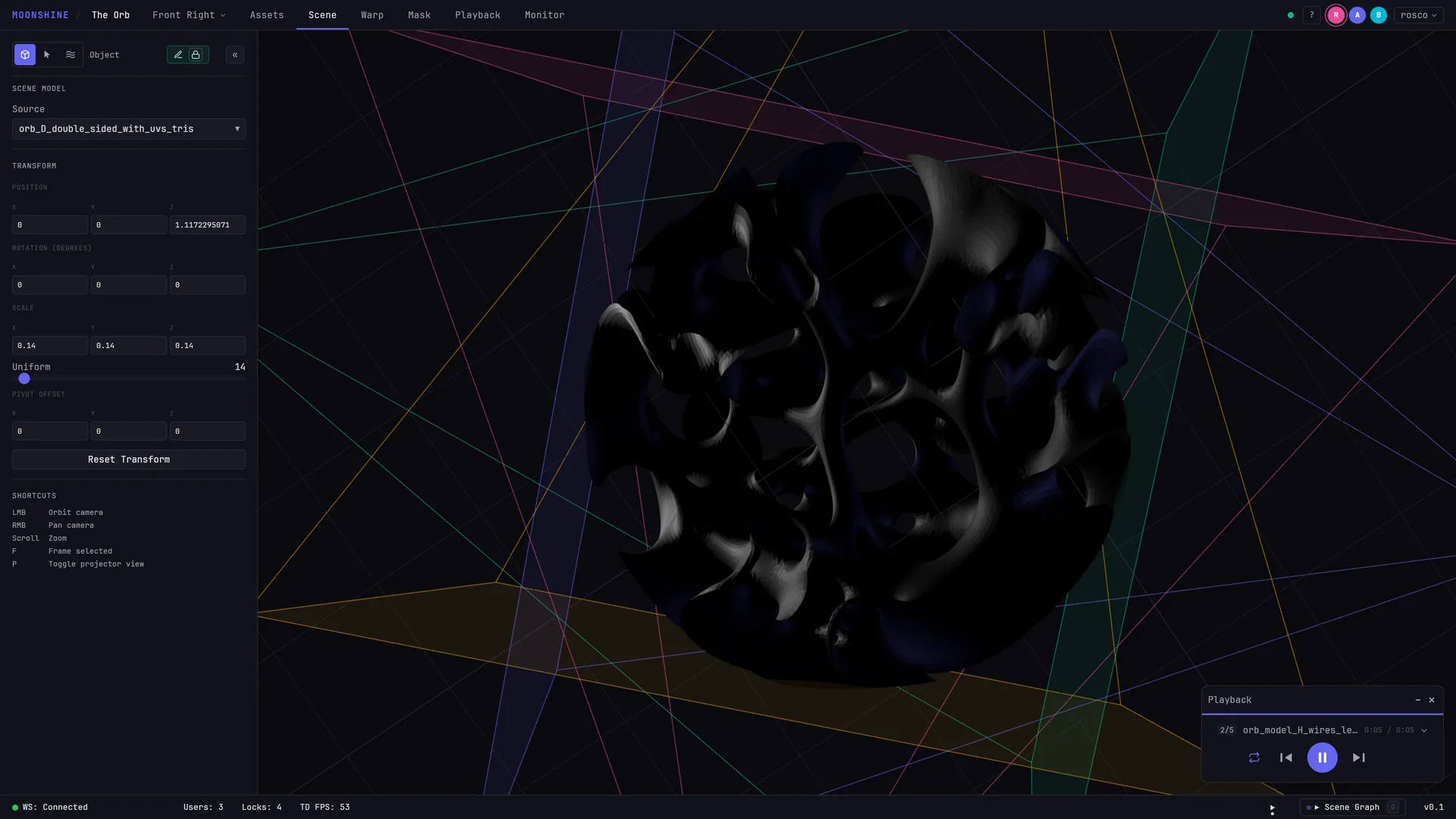
While a collaborator works on the surface, you see all of this in their color:
| Marker | Meaning |
|---|---|
| Camera outline with a name at the tip | Where they are looking from |
| A dot with a name pill on the surface | Where their pointer is right now, projected onto the geometry |
| Small faint dots | The points they currently have selected |
| A cluster of dots that moves | The points they are dragging at this moment |
The dots sit on the surface and travel with it, so as their edit lands you watch their handful of points move and the geometry follow. Nothing needs refreshing — their pull appears on your screen as they make it.
Note
Only the first 256 points of a selection are shared. If a collaborator says they have selected two thousand points and you count a couple of hundred dots, trust their number, not the dots — the edit still moves every point they selected.
How simultaneous edits resolve
Moonshine resolves conflicts one point at a time, not one surface at a time.
- Different points, at the same time: both edits apply. This is the normal case and it needs no coordination at all.
- The same point, at the same time: the most recent change wins. The surface always ends up identical on every screen — nobody is left looking at a private version — but one of the two pulls will be the one you keep.
So the failure mode is not corruption; it is disappointment. If two of you drag overlapping areas, one of you will watch their work get overwritten a moment later. Everything below is about avoiding that.
Staying out of each other's way
- Split the surface out loud. "You take stage left of the doorway, I'll take stage right." A verbal boundary is worth more than any interface feature.
- Look before you drag. Their colored dots tell you where they are working. If their dots are inside the area you are about to grab, wait or pick somewhere else.
- Mind your falloff. A wide soft radius reaches much further than the points you can see highlighted. When you are working near a collaborator, shrink the radius — the influence of a large soft brush is exactly what silently overlaps someone else's area.
- Work in short pulls. Frequent small drags publish sooner and overlap for less time than one long drag across half the surface.
- Use follow for handovers. When you want a second opinion on a specific seam, have them follow you instead of describing where to orbit.
Tip
Two people can end up circling the same detail without noticing. The colored dots are the tell — if their pointer dot keeps landing inside the patch you are working, you are on the same few centimetres of surface and it is time to agree who has it.
Undo with other people on the surface
While you are shaping the surface, undo (Ctrl+Z, or Cmd+Z on a Mac) puts back the points you moved on your last pull, and only those. It does not roll back the surface as a whole and it never reverses a collaborator's edit somewhere else. Your collaborators see the points snap back as you press it, exactly as they saw them move.
If a collaborator has since moved a point that your undo also touches, the usual rule applies — the most recent change wins, and here your undo is the most recent change.
Actions that are not shared
Sculpting is collaborative; committing the result is not. Three buttons under Warp Settings in the sidebar change what everyone works from, so agree on who presses them and when:
| Button | Effect | Guarded? |
|---|---|---|
| Bake Warp | Commits the current shaping as the surface's baseline | Disabled while another operator holds that warp |
| Revert to Source | Discards the shaping and returns to the imported geometry. Only appears once the surface has been baked | Disabled while another operator holds that warp |
| Reset Warp | Clears all warp modifications | Not guarded — it asks Reset all warp modifications? This cannot be undone. and then does it |
Reset Warp is the one to be careful with. It is not undoable and it is not blocked by anyone else's work, so say it out loud before you press it. See Baking and reverting for what each one does.
Related pages
- 3D surface warping — the tools you are sharing
- Presence — colors, camera outlines, and pointer dots
- Locks — everything that is handed to one person at a time