4-corner keystone
Pull the four corners of a projector's output until its image squares up on the surface.
This is the fastest correction in Moonshine and the one to try first on any flat wall or screen. It works on one projector at a time.
Open the editor
- Open the Warp tab.
- Choose the projector you want to correct. Until you do, the canvas reads Select a projector to adjust warping. See Projectors for how projectors are picked and named.
- In the sidebar, set the mode switch to 4-Corner.
A bar across the top of the editor confirms what you are editing: a color dot matching the projector, Editing warp for, the projector's name, and its output resolution in pixels.
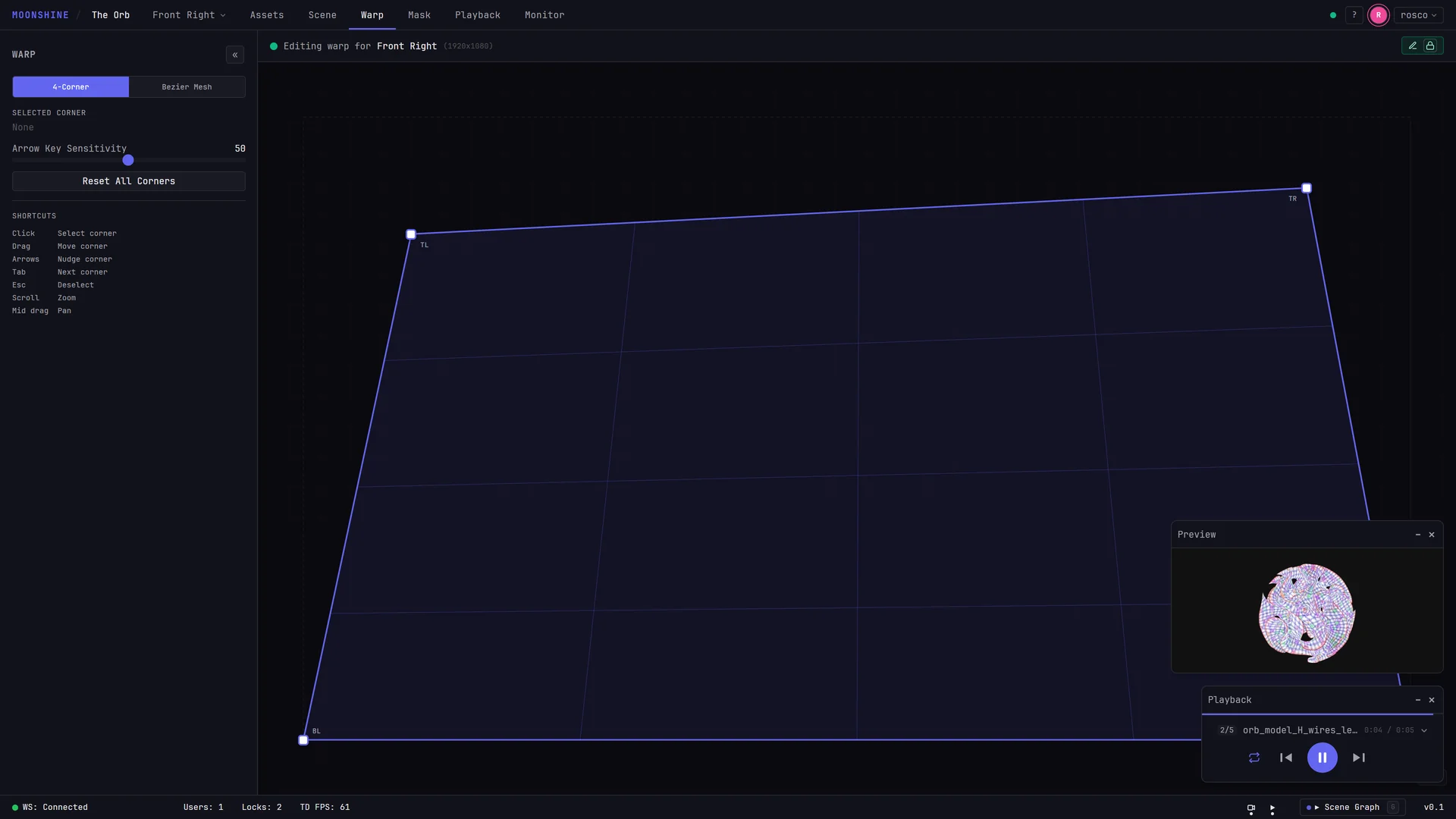
What you are looking at
| On the canvas | What it means |
|---|---|
| Dashed rectangle | The projector's uncorrected output frame, at its native aspect ratio |
| Solid quadrilateral | Where the corners currently sit |
| Interior grid lines | Quarter divisions of the corrected quadrilateral — useful for judging whether a straight line in the content will land straight |
| Square handles | The four draggable corners |
| TL, TR, BL, BR | Corner labels: top left, top right, bottom left, bottom right |
A selected handle fills in and grows slightly, and grows again while you drag it.
Move a corner
- Click a corner handle to select it. The sidebar's Selected Corner field names it and shows its current X and Y offset.
- Drag it to where the image should land, or nudge it with the arrow keys.
- Repeat for the other three corners.
Corner positions are offsets from the untouched frame, so 0.000, 0.000 means an unmodified corner. Positive X is to the right, positive Y is down. Nothing clamps them: you can drag a corner well outside the dashed frame when a projector is badly off-axis.
Corner moves stream out continuously while you drag, not only when you release the mouse, so the projected image follows the handle.
Work one corner at a time, from a distance
Set a corner, walk out and look at the surface, come back. Chasing all four corners at once on the screen produces a shape that looks right in the editor and wrong in the room.
Nudging and cycling
Once a corner is selected, the keyboard is usually faster than the mouse.
| Key | Action |
|---|---|
| Up Down Left Right | Nudge the selected corner |
| Tab | Select the next corner, clockwise from the top left |
| Shift+Tab | Select the previous corner |
| Esc | Deselect |
| Ctrl+Z / Ctrl+Shift+Z | Undo / redo |
Clicking an empty part of the canvas also deselects.
A run of quick arrow presses collapses into one undo step, so Ctrl+Z takes back the whole nudge rather than one keypress of it. A drag is likewise a single undo step.
Nudge distance
Arrow Key Sensitivity in the sidebar sets how far one arrow press moves a corner. It runs from 1 to 100 and starts at 50.
- Turn it down for the final pass, when you are chasing the last pixel of a soft edge.
- Turn it up for the first pass on a badly placed projector, where a corner has a long way to travel.
The slider hands focus back to the canvas as soon as you release it, so the arrow keys keep driving the corner instead of the slider.
Zoom and pan
| Input | Action |
|---|---|
| Scroll wheel | Zoom, centered on the pointer (25% to 800%) |
| Middle-button drag | Pan |
| Double-click empty canvas | Reset zoom and pan |
The current zoom shows in the bottom-right corner. A Reset button appears beside it whenever you are not at 100%. Zoom and pan only affect your view of the editor — they never touch the corners.
Zoom in hard when you are matching a corner to a physical edge: at 800% one screen pixel of mouse movement covers an eighth as much of the frame, so the drag lands far more precisely.
Reset
Reset All Corners returns all four corners to the unmodified frame. Moonshine asks first — Reset Keystone? This will reset all corner positions to their defaults. — with Cancel and Reset.
This clears the bezier mesh too
Because the two modes share the same corners, Reset All Corners also rebuilds that projector's bezier grid: the control points are laid back out evenly inside the unmodified frame, so any bending you did there goes with the corners. Your row and column counts are kept. If you only want to undo the last corner move, press Ctrl+Z instead.
Resetting from the scene graph
Right-clicking a projector's Keystone node in the scene graph offers Reset Keystone as well. That route resets immediately, with no confirmation, and leaves the bezier grid where it is.
Working with other operators
Keystone and bezier edits for a projector are held under a single lock. If another operator is already working on that projector's warp, the canvas and sidebar dim, your clicks and keystrokes are ignored, and the header bar names whoever is holding it. See Locks.
When four corners are not enough
If the corners are right but the image still bows, dips or drifts through the middle, the surface is not flat and no corner placement will fix it. Switch that projector to Bezier Mesh — your corner positions carry over.